

MCQs on Acute Coronary Syndrome

Written by Dr. Daniel Fraser (MBBS, FRACP) – Physician

Question 1

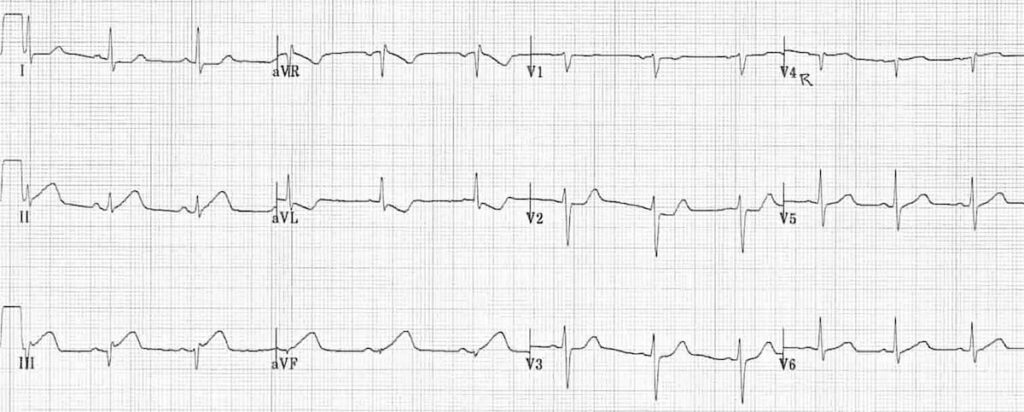
A 65-year-old man presents to the Emergency Department with complaint of chest pain radiating to his jaw for the past 2 hours. The patient is given aspirin, sublingual nitroglycerine (TNG), and supplemental oxygen. With these measures the chest pain subsides. An ECG is obtained and is as follows. A troponin level is requested with the result still pending. Which one of the following is the next best step in management?
A) Send the patient home on aspirin
B) Coronary angiogram and angioplasty
C) Thrombolysis
D) Admit and wait for the troponin results
E) Perform stress test

Correct Answer: B) Coronary angiogram and angioplasty.

This patient has typical ischemic chest pain and an ECG showing ST segment elevation in leads II, III, and aVF, consistent with an inferior ST-elevation myocardial infarction (STEMI). This makes the diagnosis definite, and immediate reperfusion therapy is required.

Therapy should be started regardless of the troponin result, as troponin may take up to 6–8 hours to become positive. A negative troponin result does not change the diagnosis or the need for urgent intervention.

According to the National Heart Foundation of Australia, Australian Clinical Guidelines for the Management of Acute Coronary Syndromes, for patients with STEMI presenting within 12 hours of symptom onset, and in the absence of contraindications, emergency reperfusion therapy with primary percutaneous coronary intervention (PCI) or fibrinolysis is recommended.

Since this patient is within the 12-hour window, angiography and stent placement (PCI) is the first-line treatment. If PCI is not available with acceptable delay, thrombolytic therapy (e.g., alteplase, tenecteplase, reteplase) is considered.

With a confirmed diagnosis of MI, sending the patient home on aspirin or performing a stress test is inappropriate. Waiting for troponin delays necessary treatment and could worsen outcomes.

Question 2

A 62-year-old man presents to your clinic for a follow-up visit. He had a myocardial infarction (MI) 4 years ago. He is currently on aspirin 80 mg daily. He follows a healthy diet and does exercise regularly. Laboratory studies are all within normal parameters. An ECG is obtained that is normal. Which one of the following is the most appropriate advice for him?

A) Reinforce the importance of a healthy diet and regular exercise
B) Stop aspirin
C) Add statins
D) Tell him he does not need any further follow-up
E) Add warfarin

Correct Answer: C) Add statins.

According to the National Heart Foundation of Australia guidelines, all patients with coronary heart disease, including those post-myocardial infarction, should be prescribed statins indefinitely, unless contraindicated. Statin therapy should have been initiated during hospitalisation and must be continued for secondary prevention of cardiovascular events.

This patient is already on lifelong aspirin, which is appropriate and should be continued unless contraindicated. Therefore, stopping aspirin (option B) is not appropriate.

Although the patient maintains a healthy lifestyle, and it is beneficial to reinforce diet and exercise (option A), this alone is not sufficient as monotherapy in secondary prevention.

Warfarin (option E) is reserved for post-MI patients with high thromboembolic risk, such as those with atrial fibrillation, mural thrombus, heart failure, or previous embolic events—none of which are present in this patient.

Telling him he does not require further follow-up (option D) is incorrect, as regular follow-up and monitoring are essential for all patients with a history of MI to prevent future events and manage medications and comorbidities.

Question 3

A 72-year-old woman is brought to the Emergency Department with chest pain of several hours duration. Of physical findings on examination, a blood pressure of 98/50 mmHg and an irregular pulse of 120 bpm are remarkable. An ECG shows ST elevation in leads V2 and V4. Which one of the following will be the most appropriate initial management option?

A) Cardioversion
B) Thrombolysis with TPA
C) Lidocaine
D) Verapamil
E) Digoxin

Correct Answer: B) Thrombolysis with TPA

This patient presents with chest pain and ST elevation in leads V2 to V4, consistent with an anterior wall ST-segment elevation myocardial infarction (STEMI). The irregularly irregular pulse at 120 bpm is suggestive of atrial fibrillation (AF), which commonly complicates acute myocardial infarction.

AF in the setting of MI is often due to left ventricular failure, atrial ischemia, or elevated left atrial pressure. Although AF is present, the primary focus of immediate management should be reperfusion therapy for the STEMI, especially if the patient presents within 12 hours of symptom onset.

In the absence of immediate access to percutaneous coronary intervention (PCI), thrombolytic therapy with agents such as tissue plasminogen activator (TPA) is the most appropriate initial treatment. Early reperfusion significantly reduces mortality and myocardial damage.

(Option A) Cardioversion may be required if the patient becomes hemodynamically unstable due to AF, but treating the STEMI takes precedence initially.
(Option C) Lidocaine is an antiarrhythmic used for ventricular arrhythmias, not for AF or MI management.
(Option D) Verapamil is a calcium channel blocker used for rate control in AF but is contraindicated in hypotension and heart failure, which may be present here.
(Option E) Digoxin is a slow-acting rate control agent for AF and not suitable in acute STEMI, particularly with hypotension.

Previous Next

2. Cardiology Module