
7.2 Infectious Skin Diseases

Question 1

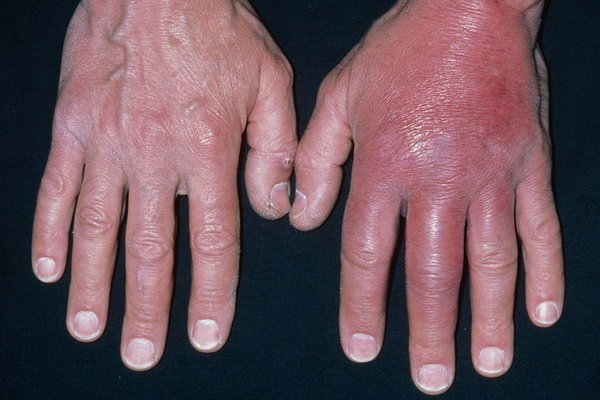
A 51-year-old man presents to the hospital with a swollen hand shown in the following photograph. He was doing some gardening at his courtyard yesterday when he had his left index finger injured. This morning, he noticed that his left hand is tender, swollen, and red. On examination, he has a blood pressure of 134/78 mmHg, pulse of 88, respiratory rate of 16 breaths/min and temperature of 38.1°C. Which one of the following is the most appropriate next step in management?
A) Ultrasound of the hand
B) MRI of the hand
C) Admission to the hospital and commencement of intravenous antibiotics
D) CT scan of the hand
E) Discharge him home on oral antibiotics and review in 24-48 hours

Correct Answer: E) Discharge him home on oral antibiotics and review in 24-48 hours

The swollen, red, and tender hand following a recent injury makes cellulitis the most likely diagnosis. Cellulitis is a clinical diagnosis, and imaging studies such as ultrasound, MRI, or CT are not required unless complications like abscess or foreign body are suspected.

The most common pathogens in non-purulent cellulitis are Streptococcus pyogenes and other Streptococcus species. Staphylococcus aureus is more common in purulent cellulitis, typically associated with penetrating trauma, ulceration, or abscess formation.

The mainstay of treatment is antibiotics. Oral antibiotics are adequate for cellulitis without systemic signs or with only one mild systemic feature, such as fever alone, as in this case (temperature 38.1°C).

Indications for hospital admission and intravenous antibiotics include:

  • Temperature >38°C or <36°C
  • Heart rate >90 bpm
  • Respiratory rate >20/min
  • Abnormal WBC count or left shift
  • Inability to tolerate oral therapy
  • Immunocompromised state
  • Significant comorbidities (e.g., diabetes mellitus)
  • Inability to ensure early follow-up

Since this patient has only one mild systemic feature (fever) and none of the above high-risk features, the best approach is to start oral antibiotics, advise rest and elevation, and ensure a review in 24–48 hours to assess response.

Question 2

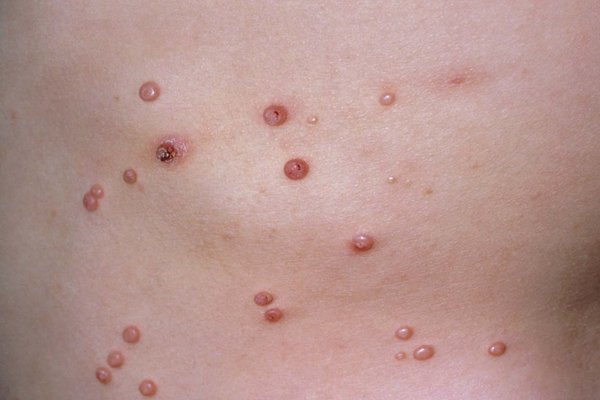
A 7-year-old girl, Evie, is brought to your general practice by her mother who is concerned about a rash she has developed, as shown in the following photograph. The rash appeared almost two months ago on her abdomen and has spread to the extent evident in the photo. There is no complaint of pain or itching, but a few lesions have ulcerated (one shown in the photograph). Evie is otherwise healthy and has not had any serious illnesses so far. Her growth charts are all normal. Physical examination is otherwise normal. She goes to school and has two younger brothers and sisters at home. Which one of the following is a correct advice to give?
A) She should be excluded from school until the resolution of the rash
B) She can go to school but should use separated towel and other personal items
C) She should be given oral acyclovir
D) Cryotherapy with liquid nitrogen is the treatment of choice for the rash
E) She should use topical steroids

Correct Answer: B) She can go to school but should use separated towel and other personal items

The lesions shown are pearly dome-shaped papules with central umbilication, which are characteristic of molluscum contagiosum, a common viral infection in children caused by molluscipoxvirus, a member of the poxvirus family.

Molluscum contagiosum presents with firm, smooth, spherical papules that are pearly white with a central dimple. Lesions typically measure 1–3 mm, but may coalesce to form larger lesions up to 1–2 cm. Common sites include flexures and areas of friction. Although it may appear in the anogenital region, this is not usually linked to sexual abuse in children.

The condition is benign and self-limiting, with spontaneous resolution occurring over 3–6 months, but sometimes taking up to 3 years. Active treatment is not usually required. When treatment is sought (e.g., for cosmetic reasons or persistent lesions), cryotherapy or curettage may be used, but they are not routinely recommended (ruling out option D).

Children should not be excluded from school (option A), but preventive hygiene measures like not sharing towels or bathing together are advisable to prevent spread.

Antiviral therapy such as oral acyclovir (option C) is not effective for molluscum contagiosum. Topical steroids (option E) are only indicated when there is associated eczema, which is not present in this case.

Question 3

A 60-year-old man presents to your clinic with complaints of fever and a painful swollen right thigh. He has diabetes well controlled on metformin 500 mg 8-hourly and hypertension for which he is taking valsartan 80 mg daily. He is on atorvastatin 20 mg daily for hypercholesterolemia as well. His recent medical history is remarkable for deep vein thrombosis (DVT) of his right leg, for which he is currently on warfarin. One week ago, he was admitted to the hospital after one episode of syncope and started on amiodarone after he was diagnosed with ventricular tachycardia (VT). Physical examination is remarkable for a temperature of 38.3°C and a warm swollen tender right thigh that is erythematous. Right thigh circumference is 3 cm greater than that of the left thigh. Which one of the following could be the most likely cause of this presentation?

A) Deep vein thrombosis (DVT)
B) Cellulitis
C) Drug interaction
D) Hematoma
E) Rhabdomyolysis

Correct Answer: B) Cellulitis

This patient presents with a warm, erythematous, swollen, and tender thigh, along with fever, which are classic signs of cellulitis. The clinical picture suggests a localized skin and soft tissue infection, rather than a systemic or mechanical cause.

Although he has a history of DVT, the fact that he is already on warfarin reduces the likelihood of a new thrombotic event (option A). Furthermore, DVT alone usually does not present with erythema and fever, which are hallmark signs of infection.

A hematoma (option D) could be suspected due to the interaction between warfarin and amiodarone, but hematomas usually present with bluish discoloration, not erythema, and are typically non-tender and not warm. Additionally, hematomas do not usually cause fever unless there is a secondary infection.

Drug interaction (option C) between warfarin and amiodarone increases bleeding risk, while interaction with atorvastatin raises the risk of myopathy or rhabdomyolysis. However, these interactions would result in systemic muscle symptoms (in the case of rhabdomyolysis) and not a focal, inflamed, and febrile presentation like this one.

Rhabdomyolysis (option E) presents with muscle pain, weakness, dark urine, and lab abnormalities like elevated creatine kinase, hyperkalemia, and possibly acute kidney injury. It is not associated with redness, swelling, and fever of a single limb.

In contrast, cellulitis—a bacterial infection of the dermis and subcutaneous tissue—commonly presents with fever, localized pain, swelling, redness, and warmth, especially in patients with risk factors like diabetes. Thus, cellulitis of the right thigh is the most likely diagnosis in this scenario.

Author – Dr. James Whitfield (MBBS, FRACGP)

With over 30 years in primary care, Dr. James Whitfield is a highly experienced GP providing comprehensive medical services for individuals and families. He has a strong background in chronic disease management, preventive health, and minor surgical procedures.
7. Dermatology Module