
7.1 Non-Infectious Skin Diseases

Question 1

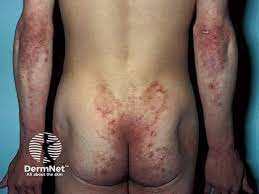
A 27-year-old man presents with extremely itchy rash on his buttocks and elbows as shown in the following photograph. He has long-standing history of celiac disease. He was also diagnosed with major depression seven months ago for which he is under treatment with Zoloft. Which one of the following could be the most likely diagnosis?
A) Linear IgA dermatosis
B) Neurotic excoriation
C) SSRI-induced dermatitis
D) Scabies
E) Dermatitis herpetiform

Correct Answer: E) Dermatitis herpetiform

The photograph shows papules and vesicles, some of which are eroded. This clinical presentation, along with a history of long-standing celiac disease, strongly suggests dermatitis herpetiform as the most likely diagnosis.

Dermatitis herpetiformis (also known as Duhring-Brocq disease) is a rare, immune-mediated bullous skin condition that presents with clusters of extremely itchy vesicles and papules, typically on the elbows, knees, scalp, shoulders, and buttocks. The condition is called herpetiform due to the clustered appearance of blisters, resembling those of herpes simplex, though it is not viral in origin.

There is a strong association between dermatitis herpetiformis and celiac disease, with over 90% of patients having gluten-sensitive enteropathy. Around 15–25% of patients with celiac disease develop dermatitis herpetiformis, and these patients usually have more severe intestinal pathology.

The immune response involves IgA deposition in the dermal papillae, triggered by gluten ingestion, particularly the gliadin component. Lesions typically form in symmetric clusters, and scratching often causes vesicles to rupture, leaving flat erosions or crusts.

Linear IgA dermatosis (option A) is another autoimmune blistering disease, but it’s usually drug-induced (commonly by vancomycin) and has a different distribution and morphology.

In neurotic excoriation (option B), lesions are self-inflicted and vesicles are typically absent, making it less likely.

SSRI-induced dermatitis (option C) presents with macular or urticarial rashes, not grouped vesicles with a celiac background.

Scabies (option D) presents with burrows and intense itching, commonly in web spaces, not vesicles over extensor surfaces in a symmetric pattern with strong association to celiac disease.

Question 2

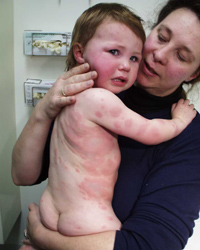
A 2-year-old boy is brought to the emergency department, by his mother, after he developed a rash following a bee sting 20 minutes ago. The appearance of the rash is shown in the following photograph. On examination, there is no breathlessness, wheezing, abdominal pain, or hemodynamic instability. Which one of the following is the most appropriate management?
A) Intravenous epinephrine
B) Intravenous diphenhydramine
C) Intramuscular epinephrine
D) Oral promethazine
E) Oral corticosteroids

Correct Answer: D) Oral promethazine

The rash described and shown is consistent with generalized urticaria (hives), which is a common skin manifestation of immediate hypersensitivity reactions such as bee stings. However, since the child is hemodynamically stable and not experiencing respiratory symptoms or gastrointestinal involvement, this does not constitute anaphylaxis.

In cases where anaphylaxis is suspected, marked by:

  • Hypotension
  • Bronchospasm, wheezing, or stridor
  • Persistent gastrointestinal symptoms
  • Rapid onset of multiple system involvement

the correct and immediate management would be intramuscular epinephrine.

However, in isolated urticaria without systemic involvement, treatment focuses on symptomatic relief, and oral antihistamines such as promethazine are the mainstay of therapy.

  • Option A and C (epinephrine): Indicated only for anaphylaxis, which this case does not meet.
  • Option B (IV diphenhydramine): Reserved for more severe cases or when oral administration is not possible.
  • Option E (oral corticosteroids): Considered if there is no response to antihistamines.

Therefore, the most appropriate management in this scenario is oral promethazine.

Question 3

A 17-year-old girl presents to your GP practice with redness and swelling of the sun-exposed areas of her face after she spent 60 minutes in the sun. She is on treatment for acne. On examination, erythema and edema of the sun-exposed areas of her face, neck and upper chest are noted. There are bullae all over the area. Which one of the following is the most likely diagnosis?

A) Doxycycline phototoxicity
B) Allergic contact dermatitis
C) Erythromycin phototoxicity
D) Stevens – Johnson syndrome
E) Benzoyl peroxide phototoxicity


Correct Answer: A) Doxycycline phototoxicity

This presentation is typical of a phototoxic drug eruption, most commonly triggered by medications such as doxycycline, which is frequently prescribed for acne. Phototoxic reactions occur when a drug absorbs ultraviolet A (UVA) light, leading to direct cellular damage.

The rash typically appears in sun-exposed areas, such as the face, neck, and upper chest, and can resemble an exaggerated sunburn, sometimes with blistering or bullae, as seen in this patient.

  • Phototoxicity is dose-dependent and more common than photoallergy. Tetracyclines, especially doxycycline, are well-known culprits.
  • Photoallergic reactions, in contrast, are immune-mediated and typically present with eczema-like rashes, not bullae.

Option B (Allergic contact dermatitis) typically presents with eczema, not bullae, and requires contact with an allergen, not sun exposure.
Option C (Erythromycin phototoxicity) is incorrect because erythromycin has not been shown to significantly cause phototoxicity.
Option D (Stevens-Johnson syndrome) presents with mucosal involvement and widespread skin necrosis, not restricted to sun-exposed areas.
Option E (Benzoyl peroxide phototoxicity) is incorrect as benzoyl peroxide is not associated with phototoxic reactions.

Thus, doxycycline phototoxicity is the most likely diagnosis.

Author – Dr. James Whitfield (MBBS, FRACGP)

With over 30 years in primary care, Dr. James Whitfield is a highly experienced GP providing comprehensive medical services for individuals and families. He has a strong background in chronic disease management, preventive health, and minor surgical procedures.

Previous Next

7. Dermatology Module