
12.6 Bone Tumors

Question 1

A 15-year-old boy is brought by his parents because of a painless swelling just above his left knee. The swelling has been present for over a year and has slowly increased in size. There is no history of trauma, fever, or weight loss. On examination, there is a hard, immobile, non-tender mass arising from the medial aspect of the distal femur. The overlying skin is normal. X-ray of the knee is shown below.
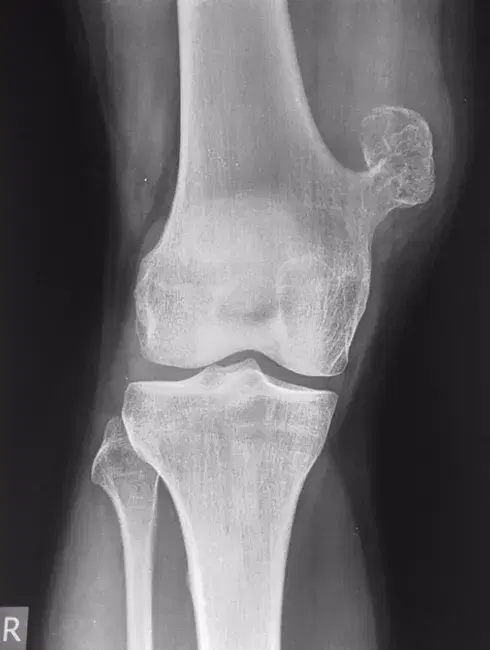
Which of the following is the most likely diagnosis?

A) Osteosarcoma
B) Osteochondroma
C) Osteoid osteoma
D) Fibrous dysplasia
E) Chondrosarcoma

Correct Answer: B) Osteochondroma


Explanation:
Osteochondroma is the most common benign bone tumor, typically occurring in children and adolescents. It usually arises from the metaphyseal region of long bones (especially around the knee — distal femur, proximal tibia) and is characterized by a bony exostosis capped by cartilage.

Radiographically, the lesion appears as a bony projection with cortical and medullary continuity with the underlying bone, which is pathognomonic. These tumors are often asymptomatic and found incidentally, but may cause symptoms due to mechanical irritation or nerve compression.


Key points in diagnosis:

  • Age: Adolescents and young adults.
  • Location: Metaphysis of long bones.
  • Imaging: Shows continuous cortex and medullary canal with host bone.
  • Symptoms: Usually painless; pain suggests complications such as fracture, bursa formation, or malignant transformation (rare).

Differential diagnosis:

  • Osteosarcoma: Presents with pain, rapid growth, and destructive lesion; often has periosteal reaction (sunburst or Codman’s triangle).
  • Osteoid osteoma: Small lesion, night pain relieved by NSAIDs.
  • Fibrous dysplasia: Ground-glass radiologic appearance.
  • Chondrosarcoma: Malignant cartilage tumor, usually in older adults, with destructive growth and pain.

Management:

  • Observation for asymptomatic cases.
  • Surgical excision if symptomatic, causing functional issues, or showing signs of malignant change (rapid growth after skeletal maturity, pain, or cartilage cap >2 cm).

Question 2

A 38-year-old woman presents with mild swelling and occasional discomfort in her left index finger for the past 6 months. She denies any trauma, fever, or constitutional symptoms. On examination, there is a firm, non-tender swelling over the distal phalanx. There is no redness or warmth. X-ray of the hand is shown below.
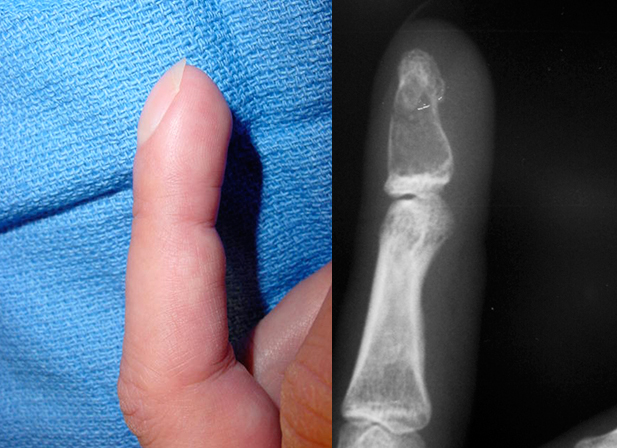
Which of the following is the most likely diagnosis?

A) Chondrosarcoma
B) Osteoid osteoma
C) Enchondroma
D) Giant cell tumor
E) Fibrous dysplasia

Correct Answer: C) Enchondroma


Explanation:
Enchondromas are benign cartilaginous tumors that typically occur in the medullary cavity of small bones of the hands and feet. They usually affect adults between the ages of 20 and 50 years. These lesions are slow-growing, often asymptomatic, and are found incidentally or after a pathological fracture.

Radiographically, enchondromas appear as well-defined, radiolucent lesions with stippled or punctate calcifications representing cartilage matrix mineralization. The cortex may be thinned but is typically intact unless complicated by fracture.


Key points in diagnosis:

  • Location: Common in small bones of hands/feet.
  • Radiology: Central lucent lesion, punctate calcifications, intact cortex.
  • Symptoms: Often asymptomatic; may cause mild discomfort or fracture.
  • Histology: Mature hyaline cartilage.

Differential diagnosis:

  • Chondrosarcoma: Malignant cartilage tumor; more aggressive, destructive growth; occurs in older adults (40–70 years), often in pelvis or long bones.
  • Osteoid osteoma: Night pain relieved by NSAIDs; small cortical nidus.
  • Giant cell tumor: Epiphyseal, lytic, soap-bubble appearance in skeletally mature patients.
  • Fibrous dysplasia: Ground-glass appearance, expansile lesion.

Management:

  • Observation if asymptomatic.
  • Curettage and bone grafting if symptomatic or complicated by fracture.
  • Monitor for recurrence, especially in syndromic cases (e.g., Ollier disease, Maffucci syndrome), where there is a risk of malignant transformation.

Question 3

A 17-year-old girl presents with intermittent dull pain in her right thigh for the past 8 months. She reports occasional limping but denies trauma, fever, or weight loss. On examination, there is mild tenderness over the proximal femur but no swelling or redness. X-ray of the femur is given below.
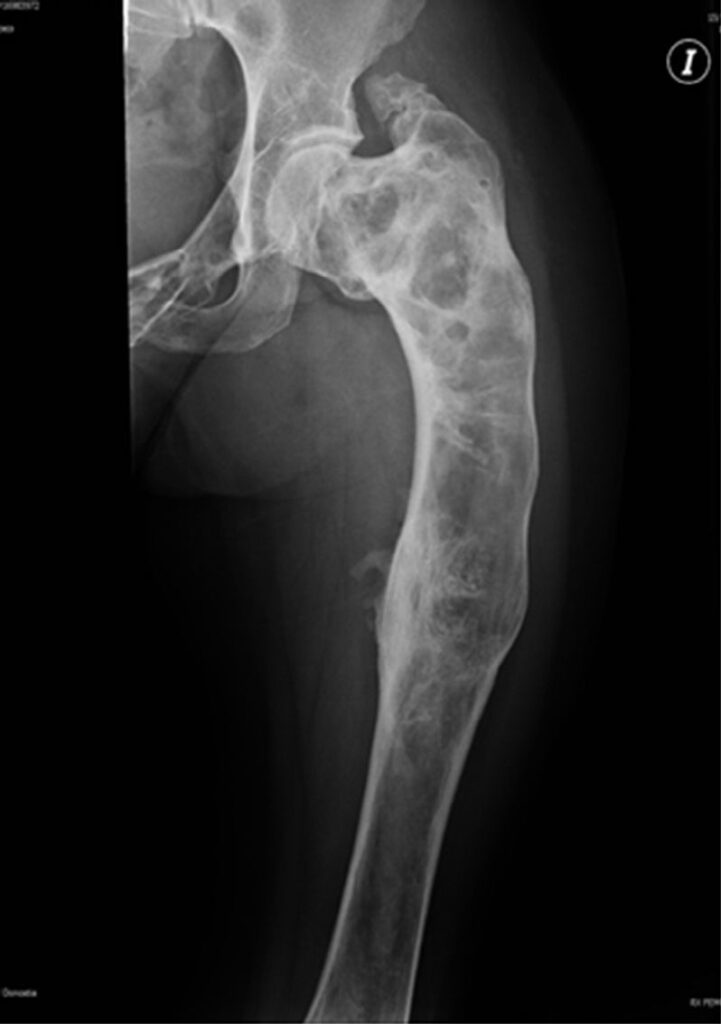
Which of the following is the most likely diagnosis?

A) Fibrous dysplasia
B) Osteosarcoma
C) Non-ossifying fibroma
D) Aneurysmal bone cyst
E) Ewing sarcoma

Correct Answer: A) Fibrous dysplasia


Explanation:
Fibrous dysplasia is a benign fibro-osseous lesion in which normal bone is replaced by immature woven bone within a fibrous stroma. It can be monostotic (single bone) or polyostotic (multiple bones). The condition usually presents in adolescents or young adults, often with mild pain, deformity, or pathological fracture.

Radiologically, fibrous dysplasia is characterized by a well-defined intramedullary lesion with a ground-glass matrix and a thinned cortex. The lesion often causes mild bone expansion and bowing, especially in weight-bearing bones.


Key points in diagnosis:

  • Age: Usually in the first 2 decades of life.
  • Location: Any bone; proximal femur, ribs, and craniofacial bones are common.
  • Radiology: Ground-glass appearance, endosteal scalloping, mild expansion, cortical thinning.
  • Symptoms: Dull pain, deformity, or fracture.

Differential diagnosis:

  • Osteosarcoma: Aggressive periosteal reaction, pain, and destruction; not typically ground-glass.
  • Non-ossifying fibroma: Eccentric, lytic metaphyseal lesion in children; sclerotic border.
  • Aneurysmal bone cyst: Expansile, lytic lesion with septations; often in younger patients.
  • Ewing sarcoma: Diaphyseal, aggressive lesion with onion-skin periosteal reaction and systemic symptoms.

Management:

  • Observation for asymptomatic lesions.
  • Bisphosphonates may be used to reduce pain.
  • Surgical intervention (curettage, bone grafting, internal fixation) for deformity correction or fracture prevention.
  • In polyostotic cases, screen for associated syndromes (e.g., McCune–Albright syndrome — triad of fibrous dysplasia, café-au-lait spots, and endocrine abnormalities).

12. Orthopedics Module