
MCQs on Lower GI Tract

Written by Dr. Andrew McAllister
(MBBS, FRACS) – Surgeon

Question 1

In which one of the following conditions of the colon, occurrence of malignant changes is most likely?

A) Adenomatous polyp
B) Melanosis coli
C) Diverticulitis
D) Ulcerative colitis
E) Familial polyposis coli

Correct Answer: E) Familial polyposis coli.

Explanation:
Familial polyposis coli, also known as familial adenomatous polyposis (FAP), carries the highest risk of colorectal cancer among the listed conditions. It is caused by a germline mutation in the APC gene, typically inherited in an autosomal dominant fashion. Patients with FAP develop hundreds to thousands of adenomatous polyps in the colon, often by adolescence. If the colon is not surgically removed, colorectal cancer is nearly inevitable by age 40.

  • Option A (Adenomatous polyp): Although these are precancerous lesions and most colorectal cancers originate from them, only a small percentage of adenomas progress to malignancy.
  • Option B (Melanosis coli): A benign pigmentation of the colon mucosa, usually due to chronic laxative use, and not associated with an increased cancer risk.
  • Option C (Diverticulitis): While short-term risk of colorectal cancer may be slightly increased after an acute episode, it does not carry a high malignant potential.
  • Option D (Ulcerative colitis): Long-standing disease (especially >10 years) does increase the risk of colorectal cancer, but the absolute risk is lower than in FAP.

Question 2

A 32-year-old woman, who has just recently migrated from Somalia to Australia, presents to your practice with complaint of severe anal pain, particularly on defecation, for the past 3 months. She mentions that at times she notices blood streaking her stool or dripping in the toilet bowl after a painful bowel movement. Examination, along with the history, confirms the diagnosis of anal fissure.
Which one of the following options is the most expected predisposing factor for this presentation in this patient?

A) Rectal cancer
B) Hemorrhoids
C) Perianal abscess
D) Rectal schistosomiasis
E) High-fiber diet

Correct Answer: D) Rectal schistosomiasis.

Explanation:
This patient presents with a chronic anal fissure, and the fact that she recently migrated from Somalia, a region where schistosomiasis is endemic, is highly significant. Rectal schistosomiasis—a form of intestinal schistosomiasis caused by Schistosoma mansoni, S. japonicum, or S. mekongi—can lead to ulcerations, pseudopolyps, inflammation, and mucosal damage in the colon and rectum. These lesions can predispose patients to anal fissures, fistulas, and abscesses.

  • Option A (Rectal cancer): Rare in a young patient and not typically associated with anal fissures.
  • Option B (Hemorrhoids): Usually cause painless bleeding, not the severe pain typical of anal fissures.
  • Option C (Perianal abscess): Can cause pain and swelling, but does not cause fissures.
  • Option E (High-fiber diet): A high-fiber diet is actually protective against fissures by preventing constipation.

Given the endemic background and the clinical features, rectal schistosomiasis is the most expected predisposing factor in this patient.

Question 3

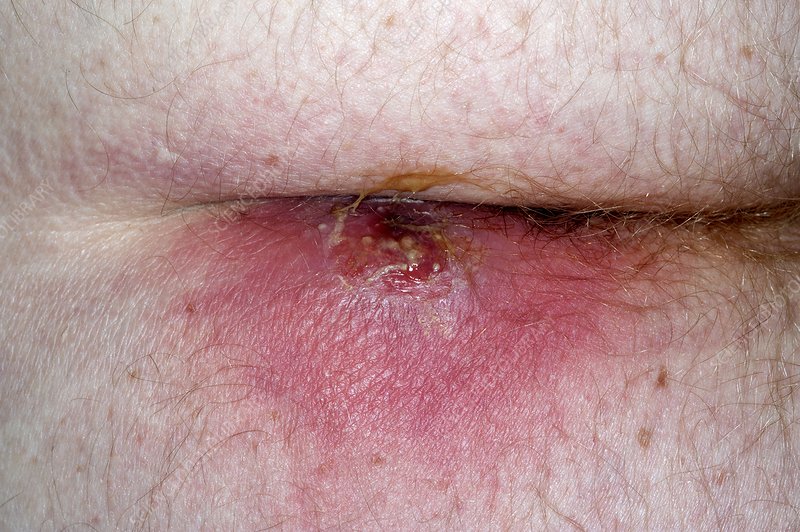
A 27-year-old woman presents to the Emergency Department with severe perianal pain started 10 hours ago that has increased progressively since then. The pain is exquisite and the patient is unable to sit. The anal region is shown in the following photograph.
Which one of the following would be the most important part of management for this patient?
A) Incision under local anesthesia
B) Hemorrhoidectomy under general anesthesia
C) Topical antihemorrhoid agents
D) Antibiotics
E) Hemorrhoidectomy under topical anesthesia

Correct Answer: A) Incision under local anesthesia.

Explanation:
The clinical presentation and photograph suggest a perianal abscess—a painful, erythematous, fluctuant mass near the anus that has rapidly worsened over hours. Patients often experience exquisite pain, especially when sitting, and this can significantly impair quality of life.

The mainstay of treatment for perianal abscess is prompt incision and drainage, which relieves pressure, removes pus, and prevents further complications. In simple cases, this can be safely done under local anesthesia in the Emergency Department.

  • Option B, C, and E (hemorrhoid-related treatments): These are inappropriate because this case is not consistent with hemorrhoids. Hemorrhoids typically present with painless bleeding, or, in thrombosed cases, with a bluish tender mass, not the erythematous fluctuant swelling seen in abscess.
  • Option D (antibiotics): Antibiotics alone are inadequate. While they may be used as adjunct therapy, they cannot replace surgical drainage, which is the definitive treatment.

Delaying incision and drainage increases the risk of chronic infection, fistula formation, or even sepsis.

8. General Surgery Module