
MCQs on Neuroimaging

Written by Dr. James Whitfield (MBBS, FRACGP) – General Practitioner

Question 1

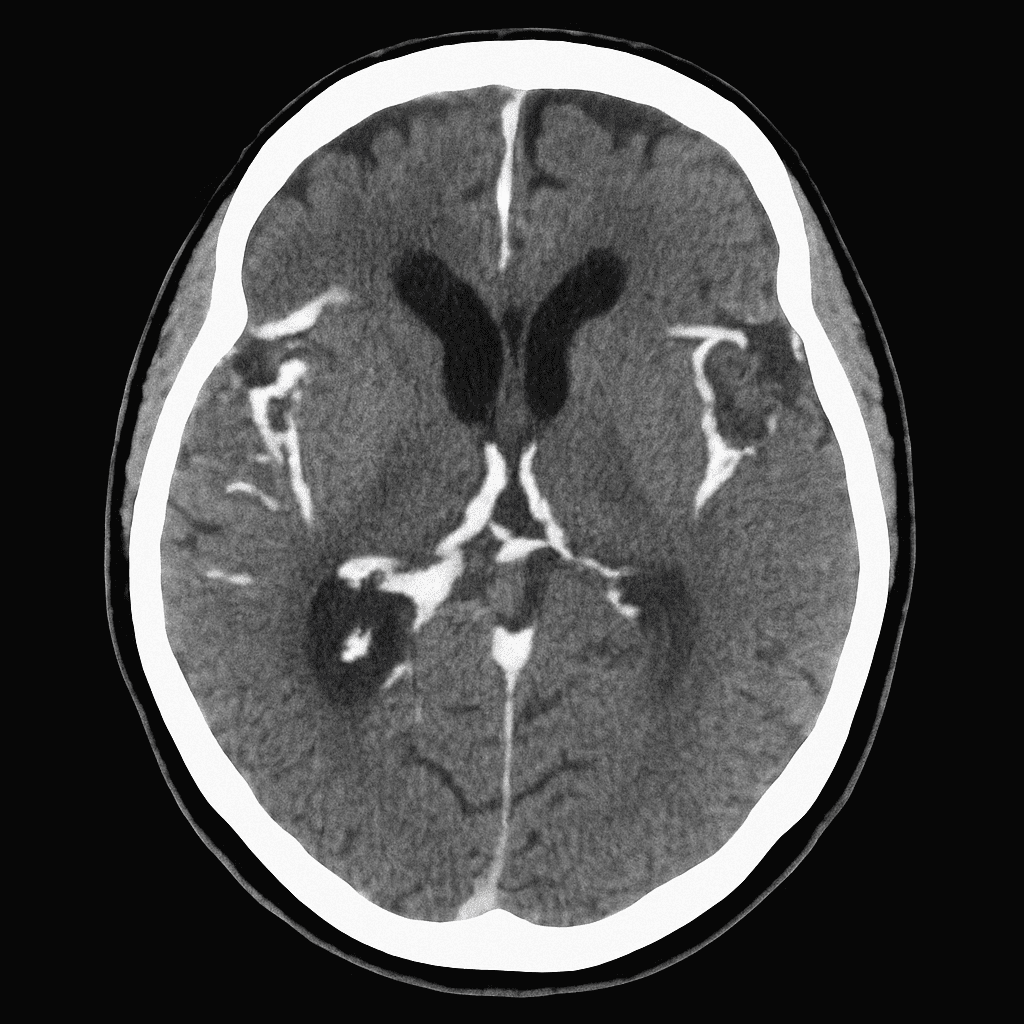
A 48-year-old woman presents to the emergency department with a sudden, severe headache that she describes as “the worst headache of my life.” The pain began abruptly while she was exercising at the gym. She vomited shortly after the onset and has been increasingly photophobic. On examination, she is alert but distressed. Neck flexion is painful, and her blood pressure is 162/98 mmHg. A non-contrast CT brain is performed and shown below.
Which of the following is the most likely diagnosis?

A) Acute migraine
B) Subarachnoid haemorrhage
C) Intracerebral haemorrhage
D) Viral meningitis
E) Acute ischaemic stroke

Correct Answer: B) Subarachnoid haemorrhage

Explanation

The CT shows hyperdense material within the basal cisterns and extending into the Sylvian fissures, which is typical of acute subarachnoid haemorrhage. Blood in the subarachnoid space appears bright on non-contrast CT.

The clinical picture aligns closely with aneurysmal subarachnoid haemorrhage: sudden “thunderclap” headache, vomiting, photophobia, and meningism (neck stiffness), often triggered by exertion.

Acute migraine (option A) may present with severe headache but will have a normal CT.
Intracerebral haemorrhage (option C) appears as an intraparenchymal hyperdense collection, not confined to cisterns or fissures.
Viral meningitis (option D) causes neck stiffness and headache but does not produce hyperdensity in subarachnoid spaces on CT.
Acute ischaemic stroke (option E) usually shows hypodensity or may initially be normal; it does not create hyperdense cisternal blood.

Question 2

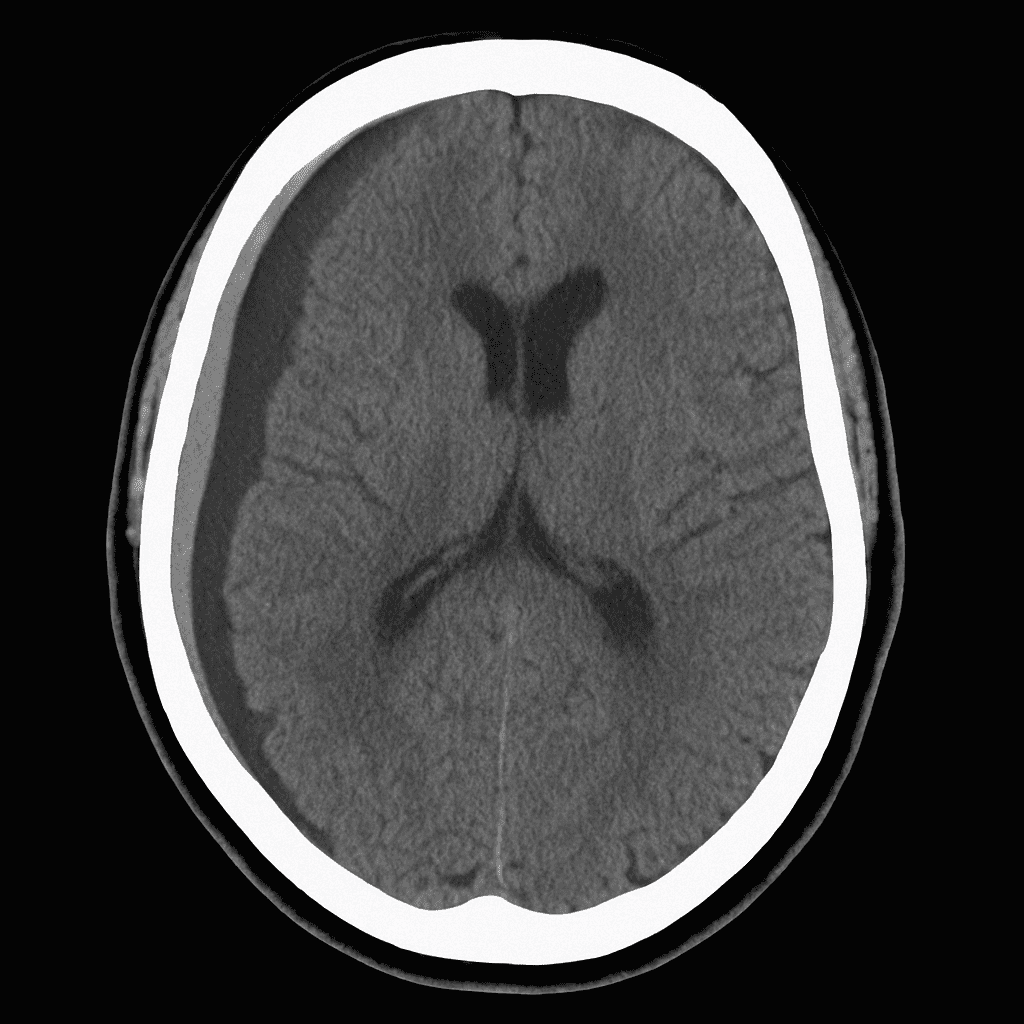
A 76-year-old man is brought to the emergency department after being found confused at home. He lives alone and his neighbour reports that he had a minor fall about two weeks ago but did not seek medical attention. On examination, he is slow to respond and has a mild right-sided weakness. His vital signs are stable. A non-contrast CT brain is performed and shown below.
Which of the following is the most likely diagnosis?

A) Acute intracerebral haemorrhage
B) Chronic subdural haematoma
C) Extradural haematoma
D) Acute ischaemic stroke
E) Brain abscess

Correct Answer: B) Chronic subdural haematoma

Explanation

The CT image shows a crescent-shaped extra-axial collection along the left cerebral hemisphere, consistent with a subdural haematoma. The density appears hypodense or isodense relative to brain tissue, which is characteristic of a chronic subdural bleed.

The patient’s age, gradual neurological decline, and history of a minor fall weeks earlier strongly support chronic subdural haematoma.

Acute intracerebral haemorrhage (option A) presents as a hyperdense intraparenchymal lesion, not crescent-shaped.
Extradural haematoma (option C) typically appears as a biconvex (lens-shaped) hyperdense collection and is commonly linked to skull fractures.
Acute ischaemic stroke (option D) may cause focal deficits but does not produce a crescentic extra-axial collection.
Brain abscess (option E) generally shows ring enhancement on contrast imaging, not the appearance shown here.

Question 3

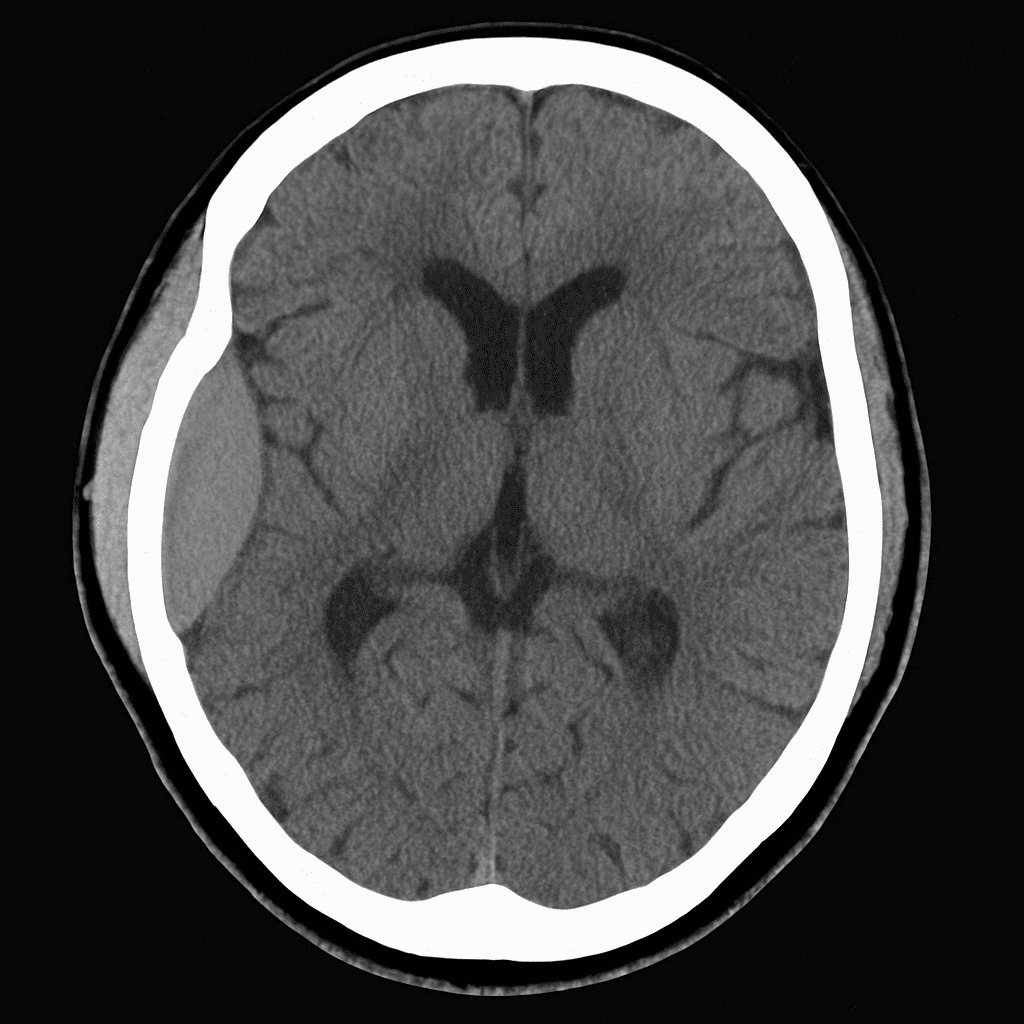
A 24-year-old man is brought to the emergency department after being struck on the side of the head during a motorbike accident. He was initially unconscious for a few minutes but became fully alert on arrival to the scene. Over the next hour, he develops worsening headache, repeated vomiting, and increasing drowsiness. On examination, his GCS has dropped from 15 to 11. A non-contrast CT brain is performed and shown below.
Which of the following is the most likely diagnosis?

A) Acute subdural haematoma
B) Extradural haematoma
C) Acute intracerebral haemorrhage
D) Traumatic subarachnoid haemorrhage
E) Cerebral contusion

Correct Answer: B) Extradural haematoma

Explanation

The CT image demonstrates a biconvex (lens-shaped) hyperdense extra-axial collection on the left side, characteristic of an extradural (epidural) haematoma. These occur due to arterial bleeding, most commonly from the middle meningeal artery, typically following temporal bone trauma.

The classic clinical pattern is seen here: brief loss of consciousness, followed by a lucid interval, then progressive neurological deterioration as the haematoma expands.

Acute subdural haematoma (option A) produces a crescent-shaped collection and is usually venous.
Acute intracerebral haemorrhage (option C) appears as a hyperdense intraparenchymal lesion.
Traumatic subarachnoid haemorrhage (option D) shows hyperdensity in sulci and cisterns, not a lens-shaped mass.
Cerebral contusion (option E) appears as patchy hyperdense areas in brain parenchyma, typically inferior frontal or temporal regions.

1. Neurology Module