
10.1 Ophthalmology – Part 1

Question 1

An 80-year-old woman presents to your GP clinic with ‘funny spots’ affecting her right vision. Over the past week, she has noticed a number of flashes and floaters in the visual field of the right eye. On physical examination, visual acuity and fields are normal. Which one of the following could be the most likely diagnosis?

A) Vitreous hemorrhage
B) Retinal detachment
C) Depression
D) Optic neuritis
E) Posterior vitreous detachment

Correct Answer: E) Posterior vitreous detachment

Explanation:
In elderly patients, the most common cause of flashes and floaters is posterior vitreous detachment (PVD), a condition resulting from age-related degeneration and separation of the vitreous from the retina. This mechanical traction on the retina during detachment leads to flashes (photopsias), while floaters arise from collagen condensations or debris within the vitreous.

PVD is very common, affecting about 66% of individuals over age 70, and typically presents without abnormalities in visual acuity or visual fields, which fits this patient’s presentation.

Other options are less likely:

  • Vitreous hemorrhage (A): Mainly causes floaters; flashes are less common. Less frequent than PVD.
  • Retinal detachment (B): Also presents with flashes and floaters but is much rarer and usually involves visual field defects.
  • Depression (C): May have somatic symptoms but not visual phenomena like flashes or floaters.
  • Optic neuritis (D): May cause flashes with eye movement and vision loss, often with retro-orbital pain, not seen in this case.

Question 2

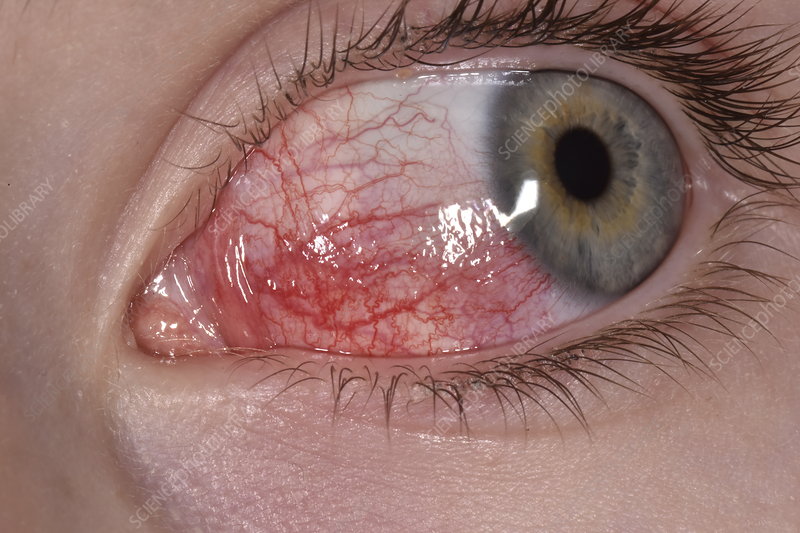
A 26-year-old woman presents with red right eye since this morning. For the past few hours she also has had mild discomfort and irritation of the eye. She denies any discharge or itchiness. On examination, eye movements, orbital pressure and visual acuity are normal. Cornea shows no abnormality and has preserved light and red reflexes. A funduscopic exam reveals no retinal abnormality either. She has unaffected visual acuity. There is a patchy redness of the sclera as shown in the following photograph. Which one of the following would be the most appropriate eye drop to consider for her?
A) Ketotifen
B) Hypomellose
C) Sodium cromoglycate
D) Prednisolone
E) Chloramphenicol

Correct Answer: B) Hypomellose

Explanation:
This patient presents with signs and symptoms most consistent with episcleritis, a mild, self-limiting inflammation of the episcleral tissue. It commonly presents with localized, patchy redness, mild discomfort, and no discharge or visual changes. The condition typically does not affect visual acuity, and physical exam findings (including normal red and light reflexes and absence of tenderness or photophobia) support this diagnosis.

The first-line treatment is artificial tears, such as Hypomellose, which help relieve irritation and promote healing. Most cases respond well to this conservative approach.

Other options are less appropriate:

  • Ketotifen (A) and Sodium cromoglycate (C) are used for allergic conjunctivitis, which typically presents with itchiness and watery discharge—absent here.
  • Prednisolone (D) is a topical corticosteroid, reserved for more severe or refractory cases.
  • Chloramphenicol (E) is used to treat bacterial conjunctivitis, which typically features purulent discharge and sticky eyelids, especially in the morning—also absent in this case.

Question 3

A 48-year-old woman presents to your practice with complaints of a painful red eye and decreased vision that has started and progressed since 3 days ago. On examination, the left eye is red, but the cornea is normal in appearance with preserved light and red reflexes. Vision is 4/12 on the left and 10/12 on the right side. The orbit movement are preserved and painless. Which one of the following could be the most likely diagnosis?

A) Glaucoma
B) Conjunctivitis
C) Blepharitis
D) Uveitis
E) Keratitis

Correct Answer: D) Uveitis

Explanation:
This patient presents with painful red eye and reduced visual acuity, with a normal cornea and preserved red reflex, making anterior uveitis the most likely diagnosis. Uveitis refers to inflammation of the uvea, especially the anterior segment (iris and ciliary body). It often presents with gradually progressive eye pain, perilimbal redness, photophobia, and blurred vision.

The presence of normal intraocular structures, no discharge, and no corneal changes, along with normal orbital movements, further supports the diagnosis of uveitis over other conditions.

Other options are less likely:

  • Glaucoma (A): Acute angle-closure glaucoma presents with hazy cornea, fixed mid-dilated pupil, loss of red reflex, and often severe pain, nausea, and vomiting—none of which are present here.
  • Conjunctivitis (B): Typically presents with discharge, itching, and preserved vision. It’s not painful, and the redness is usually more diffuse.
  • Blepharitis (C): Involves eyelid inflammation, often with itching, crusting, and conjunctival irritation, not deep eye pain or visual loss.
  • Keratitis (E): Would present with corneal abnormalities, photophobia, and often foreign body sensation, which are not found on examination here.
Previous Next

10. Ophthalmology Module