
10.2 Ophthalmology – Part 2

Question 1

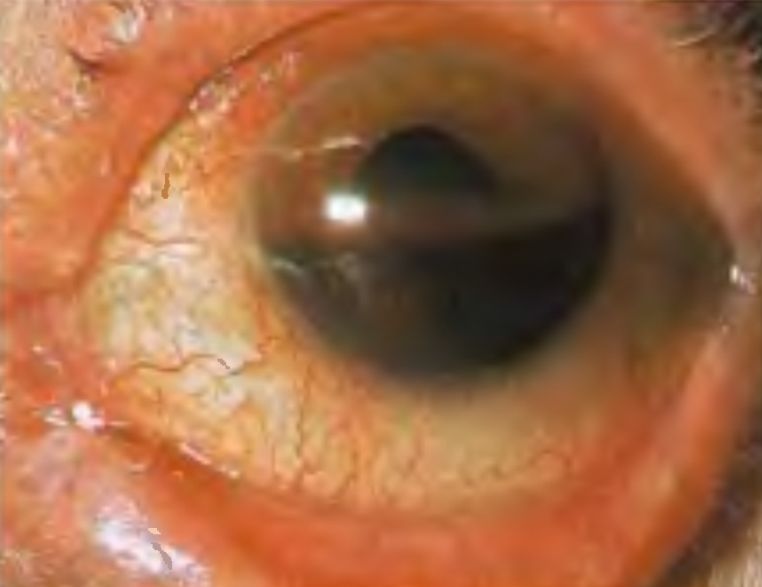
A 38-year-old woman presents to the emergency department after getting hit in her right eye with a squash ball in a match. On examination, the visual acuity of the affected eye is decreased. The eye is shown in the accompanying photograph. Which one of the following is the most appropriate next step in management?
A) Application of an eye patch.
B) Topical antibiotics.
C) Urgent referral to an ophthalmologist.
D) Evacuation of the blood under local anesthesia.
E) Reassurance as it resolves within 5 to 7 days.

Correct Answer: C) Urgent referral to an ophthalmologist.

The image and presentation are consistent with hyphemablood in the anterior chamber of the eye, most commonly caused by blunt trauma, especially during sports.

In traumatic hyphema, impact increases intraocular pressure, which can lead to iris and ciliary body vascular damage and bleeding. The affected eye often has impaired visual acuity, and though symptoms may improve over days, urgent referral to an ophthalmologist is essential due to risk of complications like re-bleeding, glaucoma, or corneal blood staining, all of which can threaten vision.

Option A: An eye patch or shield may help protect the eye temporarily, but does not replace urgent specialist review.
Option B: Topical antibiotics are not part of standard hyphema management unless there’s concern for concurrent corneal abrasion or infection.
Option D: Evacuation is reserved for cases with persistent elevated intraocular pressure or non-resolving hyphema and must be done by a specialist.
Option E: While most hyphemas resolve in 5–7 days, simple reassurance is inappropriate due to the potential for serious complications without early assessment.

Question 2

A 42-year-old machinist engineer comes to the emergency department with foreign body in his left eye. On examination, a metal speck is found stuck in the cornea. Which one of the following is the most appropriate management?

A) Remove the foreign body under local anesthesia.
B) Obtain an orbital X-ray.
C) Refer the patient to an ophthalmologist.
D) Cover the eye with a pad.
E) Remove the foreign body under general anesthesia.

Correct Answer: C) Refer the patient to an ophthalmologist.

In cases of a foreign body embedded in the cornea, especially metallic particles, the most appropriate and safest next step is referral to an ophthalmologist. Attempting removal without proper equipment and expertise can lead to corneal damage, infection, or scarring.

Option A: Removal under local anesthesia may be tempting, but should not be done outside an ophthalmic setting for embedded corneal foreign bodies.
Option B: An orbital X-ray is useful if the foreign body is suspected but not visible, or if penetrating injury is suspected, but not necessary here.
Option D: Eye patching is not helpful while a foreign body remains in the eye and can delay appropriate care.
Option E: General anesthesia is unnecessary for most foreign body removals and is not the first-line management.

Question 3

A 21-year-old woman presents to your office with itchy and watery eyes. Her symptoms started 2 days ago with redness of both eyes, lacrimation and itching. She wears contact lenses. On examination, her upper and lower lids are erythematous bilaterally. Which one of the following, if in history, is most consistent with the diagnosis?

A) Mucopurulent discharge.
B) A lump in the upper eyelid.
C) Reduced visual acuity.
D) Using a new preserving solution for her contact lenses.
E) Bacterial conjunctivitis 3 months ago.

Correct Answer: D) Using a new preserving solution for her contact lenses.

The bilateral itching, redness, and watery discharge with erythematous eyelids is most consistent with allergic conjunctivitis. A history of using a new contact lens solution strongly supports this diagnosis, as preservatives or ingredients in the solution may act as allergens in sensitized individuals.

Option A: Mucopurulent discharge is typical of bacterial conjunctivitis, which usually presents with thicker, sticky discharge, not just watery eyes and itching.
Option B: A lump in the eyelid suggests a chalazion or stye, not conjunctivitis.
Option C: Reduced vision is uncommon in conjunctivitis and suggests a more serious condition.
Option E: A past history of bacterial conjunctivitis is not relevant to the current allergic presentation.

10. Ophthalmology Module