
12.2 Upper Limb Fractures

Question 1

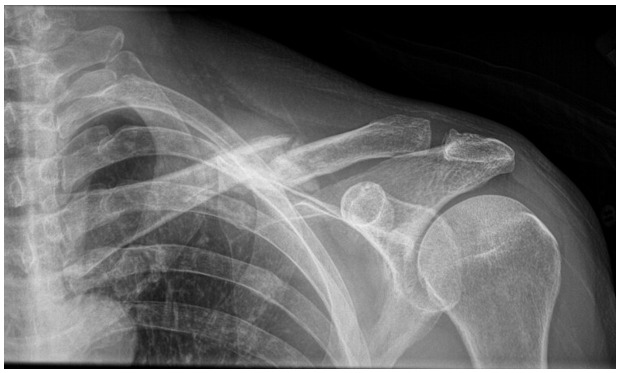
A 25-year-old man presents to the emergency department after falling off his bicycle onto his left shoulder. He reports immediate pain over the upper chest and difficulty moving his left arm. On examination, there is swelling and tenderness over the midshaft of the left clavicle, with visible deformity. Shoulder movement is limited due to pain, but distal neurovascular function is intact. An X-ray of the left clavicle is given below.
Which of the following is the most likely diagnosis?

A. Anterior dislocation of the shoulder
B. Clavicle fracture
C. Acromioclavicular joint separation
D. Proximal humeral fracture
E. Scapular fracture

Correct answer: B. Clavicle fracture


Explanation:

History & Clinical Examination

  • Mechanism of injury: Falls onto the shoulder or outstretched hand are classic causes.
  • Symptoms: Immediate pain over the collarbone, inability to raise the arm, and a sense of “something broken” in the shoulder area.
  • Signs: Localized tenderness, swelling, visible step deformity over the clavicle, and reluctance to move the arm. The patient often supports the affected limb with the opposite hand.
  • Neurovascular exam: Usually normal, but always assess the brachial plexus and subclavian vessels.

X-ray Features

  • Standard imaging: Anteroposterior (AP) view of the clavicle.
  • Findings: Discontinuity of the bone cortex, displacement or angulation of the fragments, most commonly in the middle third (≈80% of clavicle fractures).
  • May also show comminution or shortening of the bone depending on the severity.

Key point:
The midshaft of the clavicle is the weakest point and is the most frequent site of fracture. Diagnosis is made by correlating the trauma history, focal tenderness on exam, and characteristic fracture line seen on X-ray.

Question 2

A 25-year-old man falls onto his outstretched hand during a rugby match and complains of pain and deformity over his right shoulder. On examination, there is tenderness over the middle third of the clavicle with a visible bump and limited shoulder movement. Neurovascular examination is normal.

Which of the following statements regarding clavicle fractures is correct?

A) The middle third is the most common site of fracture due to its relative anatomical weakness
B) Clavicle fractures frequently cause injury to the brachial plexus and subclavian vessels
C) Surgical fixation is routinely recommended for all clavicle fractures to prevent malunion
D) Clavicle fractures rarely heal without surgical intervention
E) Fractures of the lateral third are most commonly associated with pneumothorax

Correct Answer: A) The middle third is the most common site of fracture due to its relative anatomical weakness

Clavicle fractures account for about 5–10% of all fractures, with the middle third (midshaft) being the most common fracture site due to its thinner cross-section and lack of muscle attachments compared to medial and lateral thirds.

Injury to the brachial plexus or subclavian vessels (B) is rare but can occur in high-energy trauma or displaced fractures. Surgical fixation (C) is reserved for displaced fractures with significant shortening, open fractures, or nonunions, not routinely for all fractures. Most clavicle fractures heal well with conservative treatment such as sling immobilization.

Fractures of the lateral third (E) are less commonly associated with pneumothorax; that complication is more often related to high-energy thoracic trauma involving ribs or the lung directly.

Question 3

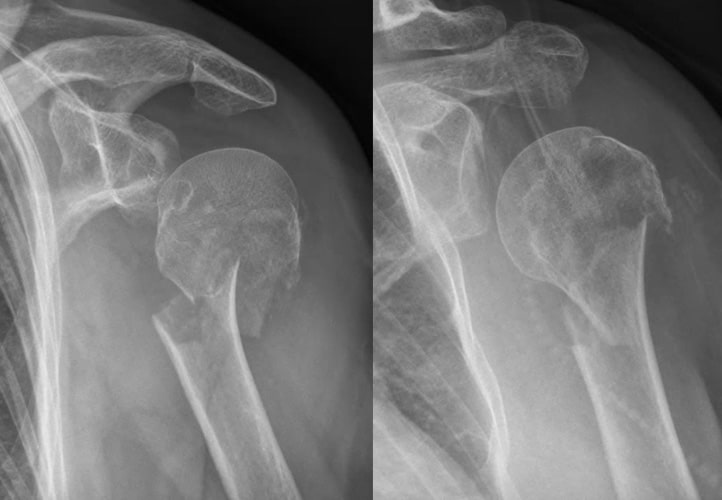
A 72-year-old woman presents to the emergency department after tripping on a rug and falling onto her outstretched right hand. She reports severe pain in the right shoulder and upper arm. On examination, there is swelling, bruising, and marked tenderness over the proximal humerus. Passive and active shoulder movements are limited due to pain. Distal neurovascular examination is normal.
An X-ray of the right shoulder is given below.
Which of the following is the most likely diagnosis?

A. Anterior shoulder dislocation
B. Clavicle fracture
C. Proximal humerus fracture
D. Rotator cuff tear
E. Acromioclavicular joint separation

Correct answer: C. Proximal humerus fracture


Explanation:

History & Clinical Examination

  • Mechanism of injury: Common in older patients after low-energy falls, often onto an outstretched hand (FOOSH) or directly onto the shoulder.
  • Symptoms: Acute shoulder pain, swelling, inability to move the arm.
  • Signs:
    • Tenderness and swelling over the upper humerus
    • Ecchymosis that may extend down the arm within 24–48 hours
    • Limited active and passive movement due to pain
    • Always assess for axillary nerve injury (sensory loss over lateral shoulder, weakness of deltoid) and vascular compromise.

X-ray Features

  • Standard views: AP and lateral shoulder views.
  • Findings:
    • Fracture line through the surgical neck or other parts of the proximal humerus
    • Displacement or angulation of the humeral head or shaft
    • Classification often based on Neer’s system (number of displaced fragments).

Key point:
In elderly patients, osteoporosis makes the proximal humerus susceptible to fracture even after minor trauma. Distinguishing it from shoulder dislocation is important — dislocation often shows loss of normal humeral head position relative to the glenoid, while fracture shows disruption in the humeral bone continuity.

12. Orthopedics Module